


Rock 'n' roll pioneer Bo Diddley, has died at the age of 79. Diddley died of heart failure at his home in Archer, Florida, his management agency said in a statement. Diddley had suffered a heart attack in August 2007, three months after suffering a stroke while touring in Iowa.
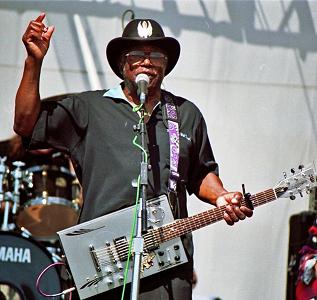
Bo Diddley was well known for the “Bo Diddley beat,” a rumba-like beat, similar to “hambone”, a style used by street performers who play out the beat by slapping and patting their arms, legs, chest, and cheeks while chanting rhymes. Occasionally (but incorrectly) referred to as a “shave and a haircut” beat, Diddley came across it while trying to play Gene Autry's “(I've Got Spurs That) Jingle, Jangle, Jingle”. Three years before Bo's “Bo Diddley,” a song that closely resembles it, “Hambone,” was cut by Red Saunders' Orchestra with The Hambone Kids.
In recent years, Bo Diddley had received numerous accolades in recognition of his role as one of the founding fathers of rock and roll. In 1986, he was inducted into the Washington Area Music Association's Hall of Fame. The following year saw his induction into the Rock and Roll Hall of Fame. His pioneering contribution to rockabilly has been recognized by the Rockabilly Hall of Fame.
In 1996, he received a Lifetime Achievement Award from the Rhythm and Blues Foundation. The following year saw his 1955 recording of his song “Bo Diddley” inducted into the Grammy Hall of Fame as a recording of lasting qualitative or historical significance. He received a Grammy Lifetime Achievement Award in 1998.
Recommended links:
Bo Diddley's Wikipedia
http://en.wikipedia.org/wiki/Bo_Diddley
Bo Diddley – The Originator
http://members.tripod.com/~Originator_2/index.html
Historic Photographs of Bo Diddley
http://www.backstagegallery.com/artist/BoDiddley.html
Additional text: Bo Diddley. (2008, June 3). In Wikipedia, The Free Encyclopedia. Retrieved 01:24, June 3, 2008, from http://en.wikipedia.org/w/index.php?title=Bo_Diddley&oldid=216748742
Related News:
Influential Blues player Hubert Sumlin dies at the age of 80
a giant of a man and a giant of a musician. God bless him and his musicians.
Its such a shame to lose such a great musicial inspiration !!
RIP BO