


Classical Guitar Anatomy
Classical Guitar: Artists 1 | Artists 2 | Guitars | Anatomy | History | Museum | Links
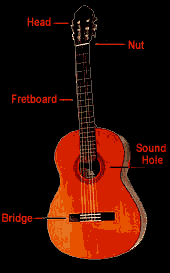
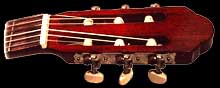
The head of the guitar is where you control the tuning of the strings. After they have passed over the nut, the strings wind around the tuning pegs, or machine heads. Tightening the string, or increasing its tension makes the pitch get higher. Loosening the string, or decreasing the tension, lowers the pitch.
At the top of the fretboard, the strings rest on the nut before winding into the tuning pegs on the head of the guitar. The amount of the string that vibrates is called the speaking length. The shorter the speaking length, the higher the pitch.
The longest the speaking length gets on the guitar is from the bridge to the nut. When you play the string’s full length, in other words, without pressing down on the string somewhere on the fretboard, it is called playing the string “open”. Chords that use open string notes are called “open chords“.
The fretboard is where you have control of the pitch and articulation of the music you play on the guitar. The classical guitar has a wider neck than other guitars which helps accommodate the finger-picking techniques. The fretboard itself is separated into sections by 19 dividers called frets. The guitar is a rhythm instrument and is designed to allow you to play chords and harmonize. Playing chords without frets would be extremely difficult.
The six strings over the 19 frets give the guitar a range of three and a half octaves. The fretboard reaches the body at the 12th fret which represents one full octave, and it ends at the soundhole. Each fret you press the string down on will increase the note by a half-step.
With an electric guitar, there are 22 or 24 frets, giving it a range of four octaves (just under with 22 frets). The fretboard begins at the nut and reaches the body at the 16th fret which represents one octave and a third, and it ends at the pick-ups. Each fret you press the string down on will increase the note by a half-step.
More on the fretboard, from Essential Guitar Guide.
Related Articles:
Cleaning Your Guitar Fretboard at Home

Between the bridge and the fretboard, you can find the soundhole. This is where the vibrations are amplified with an air-coupled resonance system. The vibrations of the strings cause the air inside the sound hole to increase the energy, which in turn causes the front of the guitar, the soundboard, to vibrate as well. Unlike an electric guitar which relies on a power amplifier to increase the loudness, the classical guitar uses this resonance system to amplify itself.
The strings tie into the part of the guitar called the bridge. The part of the bridge that touches the strings is called the bridge saddle. On a steel-string acoustic, the strings are usually held in place by six pegs which wedge into the bridge, but they slip through the bridge on a classical guitar, and then tie around it.
The distance the strings lie above the fretboard is called the action. When the action is too high, it is more difficult press the strings down to the fretboard, but when the action is too low, it can created an unwanted buzzing noise when you play. The action can be adjusted by raising or lowering the bridge saddle.
Nail Maintenance
The length, shape and surface of your fingernails have a direct effect on your playing: how you care for your nails will affect your music as much as how you practice. A short, well-shaped, smooth-edged nail will facilitate fingerstroke and produce a clear tone; a neglected nail will interfere with right hand efficiency and will sound raspy. Differences between individual nails will disrupt right hand technique even further, particularly in alternation and arpeggios. For the developing student, this can cause a great deal of wasted practice and frustration. Finally, regular and proper care of your nails is the single, foremost way to prevent them from breaking and requiring repair.
Paul’s Guitar Museum

by luthier Paul Chabot

Additional Resources…